
What is AI SEO? : How AI Is Changing Search SEO ?Imagine a potential customer searching for your service.
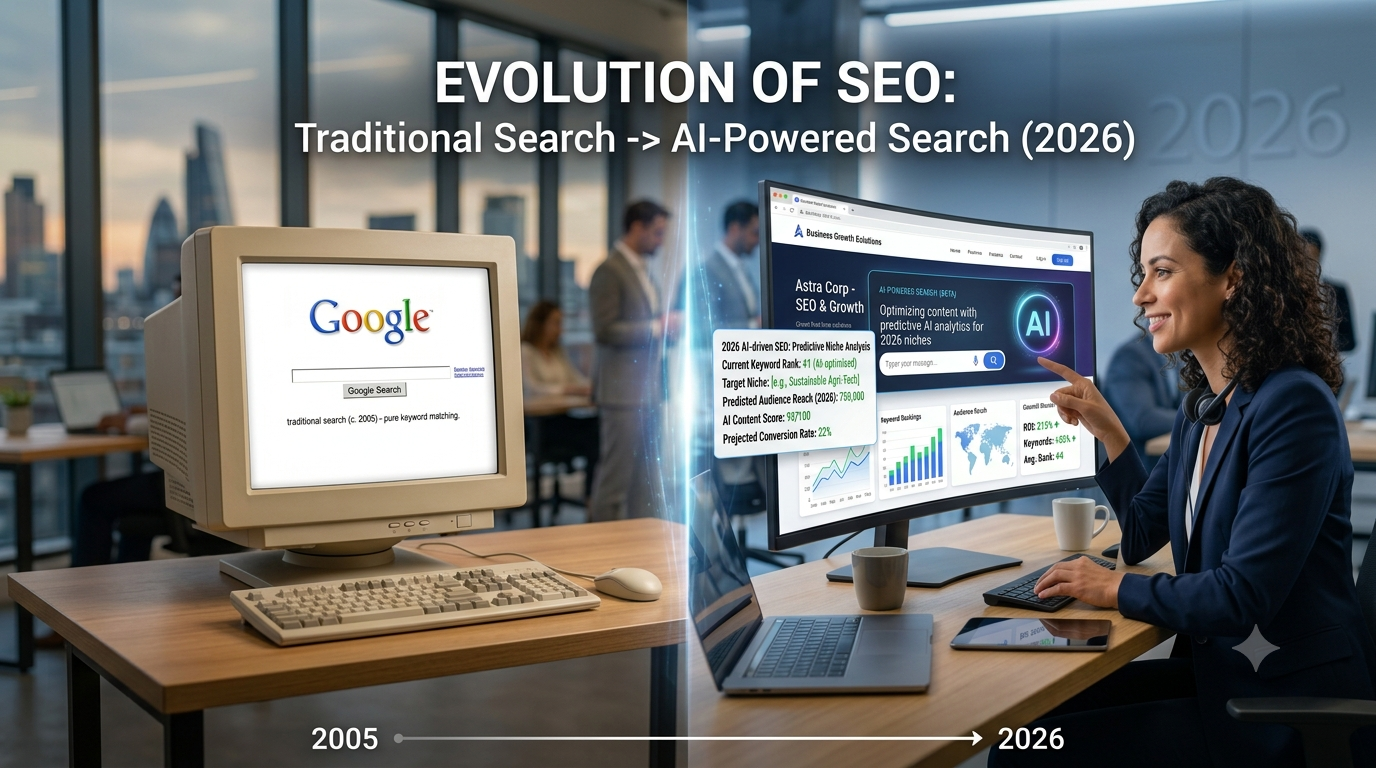
A few years ago, they might type a keyword into Google, scan several blue links, open a few websites, and make a decision.
In 2026, that journey can look very different.
Search engines increasingly use AI to understand complicated questions, connect information from multiple searches, summarize answers, and help users explore topics. Google’s AI Overviews and AI Mode are examples of this shift.
So, does this mean SEO is becoming irrelevant?
No.
AI is changing how search works, but the fundamentals of SEO still matter. Google says its generative AI search experiences are built on core Search systems, meaning crawlability, indexability, useful content, good page experience, and other SEO fundamentals remain important.
The bigger change is that businesses now need to think beyond ranking for individual keywords. They need to become a useful and trustworthy source of information.
What Is AI SEO ?
AI SEO refers to using artificial intelligence to improve activities such as keyword research, content planning, search analysis, optimization, technical auditing, and understanding user intent.
It also refers to the way AI is changing the search experience itself.
AI can help search engines understand:
- What a user is really asking
- Related concepts and entities
- Context behind a query
- Information from multiple sources
- Different ways a user may express the same need
For marketers, this means SEO is becoming less about inserting an exact keyword into a page and more about creating content that genuinely answers the user’s problem.
How AI Is Changing Search SEO ?
One of the biggest changes is the growth of AI-powered search experiences.
Google’s AI Overviews can provide an AI-generated overview for certain queries, while AI Mode is designed for more complex exploration, comparisons, and follow-up questions. These experiences can use multiple related searches, sometimes referred to as query fan-out, to gather information from different areas before producing a response.
This creates an important opportunity for websites.
A business does not necessarily have to compete only for a single traditional search result. Its useful content can potentially become one of the sources supporting an AI-generated search experience.
But there is an important distinction:
There is no secret “AI SEO hack” that guarantees inclusion in AI search.
Google’s current guidance says the same foundational SEO practices remain important for AI features. Pages must still be eligible for Google Search, and meeting requirements does not guarantee crawling, indexing, ranking, or inclusion in AI features.
How AI Is Changing Search SEO ?
AI is affecting SEO in two directions.
1. AI is changing how people search
Users can ask longer, more conversational and complicated questions instead of entering short keywords.
For example:
Traditional search:
best digital marketing agency Delhi
More conversational search:
What should a small business in Delhi look for when choosing a digital marketing agency?
The second query contains more context and a specific decision-making need.
Your content should therefore answer the underlying problem, not simply repeat the keyword.
2. AI is changing how marketers work
SEO professionals can use AI to assist with tasks such as:
- Content briefs
- Search-intent analysis
- Topic clustering
- Keyword categorization
- Content outlines
- Metadata ideas
- Content gap analysis
- Technical SEO analysis
- Updating existing content
- Identifying questions customers frequently ask
The important word is assist.
AI can accelerate SEO workflows, but human judgment is still needed to verify facts, add original insights, understand the audience, and decide what is genuinely useful.
What AI Can Do for SEO
Used responsibly, AI can become a powerful productivity tool.
Keyword and topic research
AI can help organize large keyword lists into themes and identify related questions.
For example, a business targeting local SEO might organize topics around:
- Google Business Profile
- Local rankings
- Reviews
- Local citations
- Google Maps
- Local content
- Near-me searches
This gives the content team a broader understanding of the topic rather than focusing on one keyword.
Content planning
Instead of asking AI to write 50 generic articles, use it to develop a focused content plan.
For example:
Pillar topic:
Local SEO for Small Businesses
Supporting topics:
- How Google Business Profile works
- How to improve local visibility
- How customer reviews influence local trust
- Local SEO mistakes
- Local keyword research
The result can be a more useful website structure.
Content optimization
AI can help identify missing subtopics, unclear sections, repetitive wording, and questions that a page hasn’t answered.
But optimization should improve the reader’s experience—not simply increase keyword frequency.
Technical SEO assistance
AI can also help SEO teams interpret technical issues, generate explanations, analyze patterns, or assist with repetitive tasks.
However, important technical changes should still be reviewed and tested by someone who understands the website.
What AI Cannot Replace
AI can generate text quickly.
That doesn’t automatically make the content valuable.
Google’s current guidance emphasizes unique, valuable, non-commodity content and encourages website owners to provide information that goes beyond what could easily be reproduced elsewhere.
For example, an AI-generated article saying:
“Here are 10 benefits of social media marketing.”
may provide very little differentiation.
But a digital agency could publish:
“What we learned after managing social media campaigns for three different types of small businesses—and which strategies produced different outcomes.”
The second approach has room for experience, examples, observations, and original insight.
That’s where human expertise becomes an SEO advantage.
How to Optimize Your Website for AI Search
There is no separate formula that guarantees visibility in AI search. Instead, strengthen the fundamentals.
1. Create genuinely useful content
Ask:
Would a real customer find this page useful even if Google did not exist?
If the answer is no, rethink the page.
Avoid creating large numbers of nearly identical pages simply to target every possible search variation. Google specifically warns that generating large amounts of low-value content—including content produced using generative AI—can fall under its scaled content abuse policy.
2. Add original experience and expertise
Don’t simply summarize what everyone else has already published.
Add:
- Original examples
- Case studies
- Expert commentary
- First-hand observations
- Screenshots where appropriate
- Data you actually collected
- Comparisons
- Practical processes
This makes content harder to replace with generic AI-generated material.
3. Keep your website technically accessible
AI search still depends on Google’s ability to discover and process web content.
Make sure important pages are:
- Crawlable
- Indexable
- Internally linked
- Mobile-friendly
- Fast enough for a good experience
- Available as useful text
- Free from unnecessary duplicate versions
Google’s guidance specifically recommends maintaining clear technical structure and following established SEO practices for generative AI search.
4. Use images and video when they add value
SEO is no longer purely text-based.
Relevant original images, demonstrations, diagrams, videos, and other visual content can make a page more useful. Google also recommends high-quality images and video where appropriate for generative AI search experiences.
5. Keep business information accurate
For businesses, make sure important information such as your website, services, contact details, and Google Business Profile information is accurate and consistent.
For relevant businesses, Google notes that Business Profiles and Merchant Center information can help make business and product details available across Search experiences.
AI SEO Mistakes to Avoid in 2026
AI makes it easier than ever to produce content—but easier does not always mean better.
Avoid:
- Publishing hundreds of AI-written pages without meaningful review
- Copying competitor content and rewriting it with AI
- Creating pages for every tiny keyword variation
- Stuffing keywords into AI-generated articles
- Publishing unsupported statistics or claims
- Using fake expertise or fabricated case studies
- Creating content primarily to manipulate AI search results
- Chasing every new “GEO” or “AEO hack”
Google’s current guidance specifically says there is no requirement to create special AI files, “chunk” content into tiny pieces, or rewrite content in an unnatural way solely for generative AI systems.
In other words:
Don’t optimize for AI instead of people. Optimize your website so that both people and search systems can understand its value.
A Practical AI SEO Strategy for Businesses
For a small business, you don’t need an enormous AI SEO operation.
Start with this five-step process:
1. Understand your audience
Identify the problems, questions, objections, and decisions your customers have.
2. Build topic authority
Create a useful collection of pages around your core services and expertise.
3. Add something original
Use examples, experience, research, visuals, opinions, or case studies that make your content different.
4. Strengthen technical SEO
Make your pages crawlable, indexable, fast, mobile-friendly, and easy to navigate.
5. Measure and improve
Use tools such as Google Search Console and analytics to understand search visibility, traffic, engagement, and conversions.
Google has also introduced a Generative AI performance report in Search Console, giving site owners another way to understand visibility in Google’s generative AI experiences.
What is AI SEO? Will AI Replace SEO?
No. AI is more likely to change SEO than eliminate it.
The role of SEO is expanding.
It is no longer just about:
Keyword → Page → Ranking
The modern process is closer to:
User problem → Search intent → Useful content → Search visibility → AI-assisted discovery → Website experience → Conversion
Businesses that focus only on producing more content may struggle to stand out.
Businesses that understand their audience and consistently publish useful, original, trustworthy information have a stronger foundation for both traditional search and emerging AI search experiences.
FAQs About AI in SEO in 2026
Does AI-generated content hurt SEO?
Not automatically. The bigger issue is whether the content provides value and follows Google’s Search policies. Google specifically states that using generative AI is not inherently against its guidelines, but generating large amounts of low-value content primarily to manipulate rankings can violate its scaled content abuse policy.
What is AI SEO? Will SEO still matter with AI Overviews?
Yes. Google states that its AI search experiences are built on core Search systems, so established SEO fundamentals remain relevant.
Should businesses use AI for content writing?
AI can be useful for research, brainstorming, outlining, editing, and other parts of the workflow. However, businesses should review generated content, verify important claims, and add genuine expertise and originality.
What is AI SEO? What is the most important AI SEO strategy in 2026?
Focus on creating useful, distinctive content that satisfies the user’s needs while maintaining strong technical SEO. Google describes unique, valuable, non-commodity content as particularly important for generative AI search.
Conclusion: The Future of SEO Is Human + AI
AI is changing SEO in 2026—but the smartest response isn’t to abandon traditional SEO or chase every new AI trend.
Use AI to work smarter.
Use human expertise to create something worth finding.
And use SEO fundamentals to make sure search engines can discover, understand, and connect people with it.
For businesses like UNIFmedia, the opportunity is not simply to create more content. It is to create better digital experiences—content, websites, social media, branding, and search strategies that help real people make better decisions.
The future of SEO isn’t AI versus humans.
It’s AI-assisted efficiency combined with human creativity, experience, and judgment.