

Why Blogging Is Important for SEO: 7 Powerful Benefits for Your Business
Imagine this.
You have built a beautiful website.
Your logo looks professional. Your services are clearly explained. Your website works perfectly on mobile. Your contact form is ready.
But there is one problem.
Nobody is finding you.
This is where the importance of blogging for SEO becomes clear.
Your website tells people what your business does. A blog helps people discover your business when they are searching for answers, solutions, ideas, and information online.
When done strategically, blogging can help your business target relevant search queries, increase organic traffic, build brand authority, strengthen internal linking, and generate qualified leads.
But blogging is not simply about publishing an article every week.
The real importance of blogging for SEO comes from creating useful content that answers real questions your audience is already searching for.
The importance of blogging for SEO becomes even clearer when you look at how people search online today. Customers don’t always search directly for a product or service; they search for answers, solutions, comparisons, and advice. This is why understanding the importance of blogging for SEO can help businesses create content around the questions their audience is already asking. A well-planned blog can connect those searches with your website, services, and brand while creating more opportunities to appear in relevant search results.
For businesses competing online, the importance of blogging for SEO is also closely connected to long-term visibility. Every useful article can target a specific topic, answer a customer question, support internal links, and guide readers toward relevant services. When businesses consistently publish genuinely helpful content, they can use the importance of blogging for SEO as part of a broader content marketing strategy focused on visibility, trust, organic traffic, and sustainable growth.
Let’s explore how it works.
How Does Blogging Help SEO?
The importance of blogging for SEO starts with one simple idea: search engines need useful, relevant content to understand what your website is about.
Your homepage and service pages may target your main business keywords. Your blog allows you to go deeper.
For example, a digital marketing agency may have service pages targeting:
- SEO services
- Social media marketing
- Performance marketing
- Web design
- Digital marketing
But potential customers may search for questions such as:
- How does SEO work?
- How can I increase website traffic?
- What is importance of blogging for SEO?
- How often should a business post on social media?
- How much does digital marketing cost?
- How can a small business get more customers online?
These questions create opportunities for useful blog content.
That is one of the biggest benefits of blogging for business.
1. Target Long-Tail Keywords
One of the strongest reasons for the importance of blogging for SEO is the opportunity to target long-tail keywords.
Not everyone searches using broad terms.
Someone might search:
“SEO”
while another person might search:
“how to improve SEO for a small business website.”
The second search is much more specific.
Blog posts are ideal for answering these specific questions because each article can focus on a particular topic, problem, or search intent.
For example, instead of trying to rank one service page for every SEO-related search, a business could create useful articles about:
- How to improve local SEO
- How to optimize a Google Business Profile
- How to find SEO keywords
- How blogging improves website traffic
- Common technical SEO mistakes
This is how blogging for SEO can expand the number of relevant topics your website can cover.
The goal is not to create hundreds of pages just to target keywords. The goal is to create genuinely useful content for the people you want to reach.
2. Increase Organic Website Traffic
Another major benefit of the importance of blogging for SEO is its potential to increase organic traffic.
Think about your website as a shop.
Your homepage is the front door.
Your service pages are different departments.
Your blog posts are additional doors through which people can enter your business.
Every useful article can potentially attract visitors searching for information related to your industry.
For example, a web design company could publish articles about:
- Website design
- Mobile-friendly websites
- Website speed
- Landing pages
- Conversion rate optimization
- WordPress
- User experience
A digital marketing agency could publish content about:
- SEO
- Social media
- Content marketing
- Google Business Profile
- Performance marketing
- Online advertising
This is how how blogs help SEO becomes practical.
More useful content creates more opportunities for relevant people to discover your website through search.
However, blogging does not guarantee rankings or traffic.
Competition, content quality, search intent, technical SEO, website authority, and the usefulness of the page all matter.
3. Build Brand Authority and Trust
Would you trust an agency that simply says:
“We are SEO experts.”
Or would you feel more confident about an agency that regularly explains SEO strategies, website optimization, keyword research, local SEO, and content marketing?
This is another important part of the importance of blogging for SEO.
A blog gives businesses an opportunity to demonstrate knowledge rather than simply claim expertise.
When you consistently publish useful information, potential customers can see how you think, how well you understand their problems, and whether your advice is actually helpful.
Over time, this can help build:
- Brand authority
- Familiarity
- Trust
- Expertise
- Customer confidence
For a growing business, building brand authority through content can become a valuable part of its long-term marketing strategy.
4. Create Powerful Internal Linking Opportunities
Internal linking is another reason the importance of blogging for SEO goes beyond simply getting traffic.
Imagine you publish an article called:
“How to Improve Local SEO for Your Business.”
Within that article, you could naturally link to:
- Your Local SEO service
- Your Google Business Profile service
- Your main SEO page
- A related SEO blog
- Your contact page
This creates a logical journey for visitors.
A person reads the article.
They find a relevant service.
They learn more.
Then they can contact your business.
Internal links can also help search engines understand the relationship between different pages on your website.
But remember: internal links should be useful and natural.
Do not add links simply to insert keywords.
The purpose should always be to help the reader discover relevant information.
5. Generate More Qualified Leads
Traffic is useful.
But traffic alone does not grow a business.
You also need the right visitors.
This is where the importance of blogging for SEO connects with lead generation.
Imagine someone searches:
“How to improve SEO for my small business.”
They find your blog post.
They read your advice.
They discover that your company provides professional SEO services.
They click your service page.
Then they contact you.
The journey could look like this:
Google Search → Blog Post → Useful Information → Trust → Service Page → Enquiry → Customer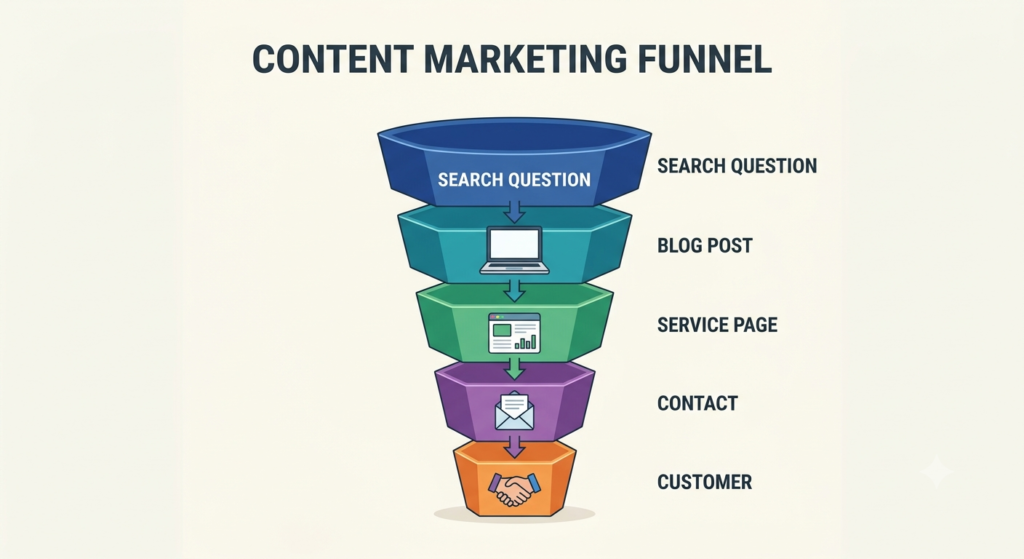
Not every visitor will become a customer.
That’s completely normal.
The purpose of business blogging is to help the right audience discover your brand and give them a useful next step when they are ready.
6. Support Your Content Marketing Strategy
A strong blog can become the foundation of a broader content marketing strategy.
One blog post can be transformed into multiple pieces of content.
For example, imagine UNIFmedia publishes an article about the benefits of SEO.
That one article could become:
- An Instagram carousel
- A LinkedIn post
- A short video
- An infographic
- A newsletter
- A social media Reel
- A Pinterest graphic
This makes the importance of blogging for SEO even greater because your blog is no longer working alone.
It becomes the central piece of a larger content ecosystem.
Your blog attracts search traffic.
Your social media distributes your ideas.
Your email marketing brings information directly to your audience.
Your service pages convert interested visitors.
Together, these channels create a stronger digital marketing system.
7. Create Long-Term Marketing Assets
Social media posts can disappear from someone’s feed within hours.
A useful blog article can continue attracting visitors long after it is published.
This is another reason businesses should understand the importance of blogging for SEO.
A high-quality article can become a long-term digital asset.
For example, a useful guide published today may continue receiving:
- Search impressions
- Organic clicks
- Social shares
- Internal links
- Backlinks
- Leads
months or even years later.
That does not mean every blog post will become a traffic machine.
Some content will perform better than other content.
The important thing is to build a useful library of content that answers the questions your customers actually have.
How to Build a Successful Business Blogging Strategy
Understanding the importance of blogging for SEO is only the first step.
The next step is creating a strategy.
Step 1: Understand Your Audience
Before choosing a topic, understand your audience.
Ask:
- Who are they?
- What problems do they have?
- What questions do they ask?
- What are they searching for?
- What prevents them from buying?
- What information do they need before making a decision?
The better you understand your audience, the easier it becomes to create useful content.
Step 2: Research Keywords and Search Intent
Don’t choose a topic simply because a keyword has a high search volume.
Understand the reason behind the search.
For example:
“What is SEO?”
usually represents informational intent.
But:
“best SEO agency for small business”
may indicate commercial investigation.
Your content strategy should cover different stages of the customer journey.
This is where blogging for SEO becomes strategic rather than random.
Step 3: Create Helpful, Original Content
Your article should give readers something useful.
Include:
- Practical examples
- Step-by-step advice
- Original explanations
- Relevant statistics when available
- Visuals
- Checklists
- Comparisons
- Real business examples
Don’t simply rewrite what other websites have already said.
Add your own perspective, experience, examples, or useful explanation.
Google’s guidance emphasizes people-first content and warns against scaled content created primarily to manipulate rankings.
Step 4: Connect Your Blog to Your Services
Your blog should support your business goals.
For every article, ask:
“What should the reader do next?”
If someone reads an SEO article, you could link them to your SEO service.
If they read a social media article, connect them with your social media management service.
If they read a website article, link to your web design service.
This creates a natural connection between information and conversion.
A Simple Business Blogging Framework
If you don’t know what to publish, use these five content categories:
| Content Type | Example |
|---|---|
| Educational | What Is Local SEO? |
| Problem-solving | Why Is My Website Not Getting Traffic? |
| How-to | How to Optimize Your Google Business Profile |
| Comparison | SEO vs PPC: What’s the Difference? |
| Commercial | How to Choose a Digital Marketing Agency |
This framework helps create a balanced content marketing strategy instead of publishing the same type of article repeatedly.
Common Business Blogging Mistakes to Avoid
The importance of blogging for SEO does not mean you should publish content simply to satisfy a keyword checklist.
Avoid these common mistakes.
Keyword Stuffing
Repeating the same phrase unnaturally can make an article difficult to read.
For example, writing ” importance of blogging for SEO” in every other sentence doesn’t make an article more valuable.
Use your primary keyword naturally and support it with related terms.
Google specifically identifies excessive and unnatural keyword repetition as keyword stuffing.
Writing Only for Search Engines
Your readers are humans.
If your content sounds robotic, readers may leave even if the article contains all your target keywords.
Write for people first.
Optimize for search engines second.
Publishing Copied Content
Copying or lightly rewriting content from other websites does not create a strong content strategy.
Instead, add original examples, practical advice, experience, research, or a unique perspective.
Ignoring Search Intent
A keyword is not enough.
You need to understand what the person actually wants.
Someone searching “what is SEO” needs an explanation.
Someone searching “importance of blogging for SEO.” may be evaluating providers.
The content should match that intent.
Forgetting the Customer Journey
Not every blog post needs to sell something.
Educate first.
Build trust.
Then provide a relevant next step.
Is Blogging Still Important for SEO in 2026?
Yes—but successful blogging looks different from simply publishing articles.
The importance of blogging for SEO is not about producing the largest number of posts.
It is about creating useful content that deserves attention.
A strong business blog can connect:
Useful Content → Search Visibility → Organic Traffic → Expertise → Trust → Leads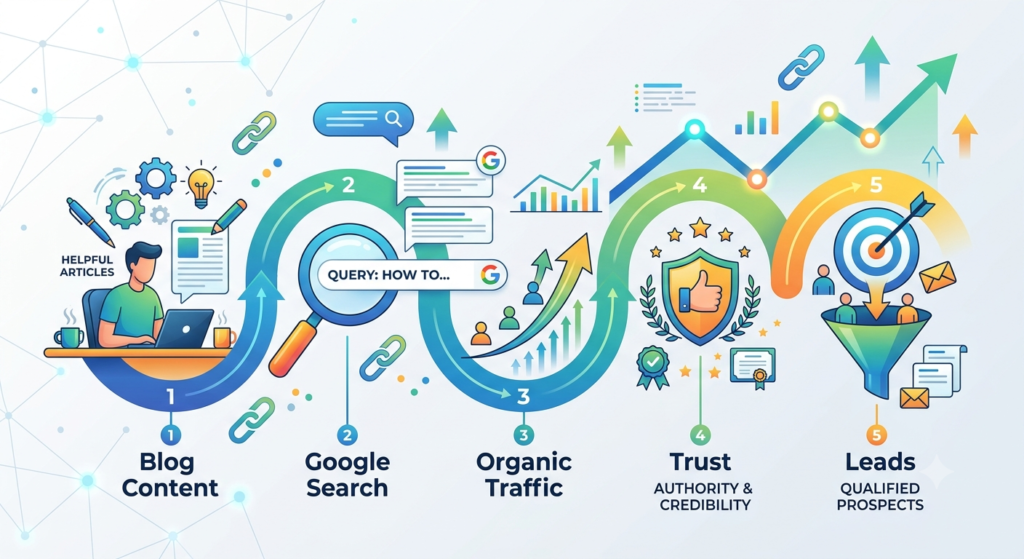
The businesses that benefit most from blogging are those that understand their audience, research search intent, create genuinely helpful content, connect articles to relevant services, know the importance of blogging for SEO and continuously improve their content.
So if your website currently has a homepage, service pages, and a contact page—but no real content strategy—there may be a major opportunity waiting for you.
Your next customer could already be searching for the answer you haven’t written yet.
Frequently Asked Questions
Why is blogging important for SEO?
Blogging is important for SEO because it gives businesses opportunities to create useful content around relevant topics and search queries. It can help attract organic visitors, support internal linking, demonstrate expertise, and guide potential customers toward relevant services.
How does blogging increase website traffic?
Blogging can increase website traffic by creating useful pages that answer questions people search for. Each relevant article can become another entry point to your website through organic search. So, business should understand the importance of blogging for SEO.
How often should a business publish blog posts?
There is no universal publishing frequency. It is better to consistently publish useful, original content than to publish low-quality articles simply to meet a schedule.
Does blogging still work for SEO in 2026?
Yes. But effective blogging requires more than keyword placement. Businesses need to create helpful, relevant, original content that satisfies search intent and provides genuine value. So, business should understand the importance of blogging for SEO.
What should a business blog about?
Businesses should write about customer questions, common problems, industry trends, how-to guides, comparisons, product or service questions, and topics that help customers make better decisions.
Final Thoughts
The importance of blogging for SEO goes far beyond rankings.
A strong blog can help your business become easier to discover, demonstrate expertise, attract relevant visitors, support your content marketing strategy, and create opportunities for new leads.
But don’t blog just because someone told you that every business needs a blog and understand the importance of blogging for SEO.
Blog because your customers have questions.
Find those questions.
Answer them better.
Create useful content.
Connect that content to your services.
And keep improving.
Because the goal isn’t to publish more.
The goal is to become more useful.
Ready to Turn Traffic Into Growth?
At UNIFmedia, we help businesses build stronger online visibility through SEO, digital marketing, social media, performance marketing, and web solutions.
Build visibility. Build trust. Build growth with UNIFmedia.